
Compared to conventional AI, the ADAGOS parsimonious neural network platform, named NeurEco©, requires a fraction of the resources and extends the battery life.
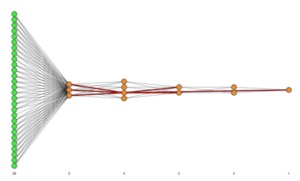
The objective is to predict the stability of a grasp through a deep learning method. The dataset contains several experiments that consist of grasping the ball, shaking it for a while, while computing a grasp robustness (which is the variation of the distance between the palm and the ball during the shake). The dataset is annotated with an objective grasp quality and contains the different data gathered from the joints (position, velocity, effort). The figure below shows the neural networks obtained with two different tools: Keras and NeurEco© 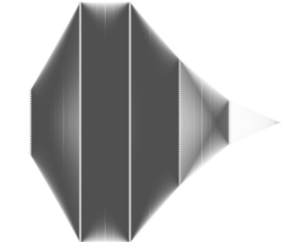
Keras neural network Relative Testing Error: 24,2%
Number of links: 121,511
NeurEco© neural network Relative Testing Error: 22,5%
Number of links: 120
To enable the implementation of the Keras model on a STM32 NUCLEO-L476RG microcontroller, it was necessary to increase the clock frequency to 80 MHz, but at the cost of high energy consumption. Conversely, the NeurEco model, lightweight by construction and more accurate, is frugal enough to allow its operation over a long period. Keras Keras NeurEco© CPU Frequency (Mhz) 4 80 4 Duration (ms)* 203.92 13.12 1.30 CPU cycles* 815,715 1,050,346 5,222 Used flash memories (Kb) 537.57 537.57 69.69 Battery life (one test every 50 ms) Not applicable (calculation too long) 10 days and 20 hours 7 months, 22 days and 8 hours For more informations, contact them!